


Their presentation, “BIM for Digital Twin: the case study of Trento,” focused on bridging the gap between 3D reality capture, building information modelling (BIM), and operational energy intelligence.
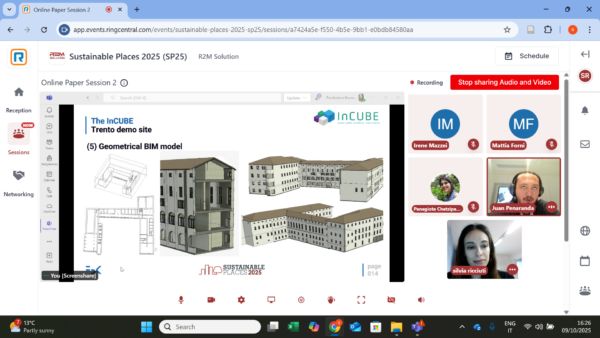
The work presented centres on the Santa Chiara district in Trento — a complex urban site that includes historical buildings, public facilities, and high occupancy rates. Renovating such a site requires more than design upgrades; it demands a precise understanding of the existing fabric and its energy behaviour.
To achieve this, the team carried out high-resolution terrestrial laser scanning using advanced TLS systems. Because urban flight restrictions limited drone use, ground-based scanning was employed to capture hundreds of scans of façades and interiors. The result was a dense, reality-based 3D point cloud — a digital replica of the physical building. But geometry alone is not a digital twin.
FBK’s contribution lies in what happens next: converting raw spatial data into structured BIM models and then translating those models into formats that support building energy modelling (BEM), monitoring systems, and predictive analytics.
This structured BIM-to-BEM workflow reduces the fragmentation that typically occurs when data passes between different software environments. Instead of losing information across platforms, the process creates a consistent digital backbone for renovation planning and operation.
The digital twin developed in Trento connects geometric models with live operational data through IoT sensors, smart plugs, and edge computing devices. Energy consumption data from specific building zones is visualised through a dedicated dashboard, providing insight into real-time performance.
Beyond monitoring, foundational forecasting models are trained on historical datasets to predict short-term energy demand. Even with limited data availability, these models can estimate 24-hour consumption trends — supporting smarter HVAC management and energy optimisation.
Across Europe, renovation is no longer optional. Energy efficiency targets, decarbonisation commitments, and the need to improve comfort and resilience in existing buildings are driving urgent action.
However, deep renovation projects often struggle with:
By combining high-accuracy 3D surveying, structured BIM modelling, energy simulation, and real-time monitoring within a unified architecture, the digital twin becomes a continuous thread linking design, implementation, and operation.
It supports:
In short, it turns renovation from a one-time intervention into an ongoing, data-driven process.
View the full presentation from Sustainable Places 2025 here.