


Simon Pezzutto (Eurac Research), coordinator of ReLIFE, opened with the project’s open-source platform for deep energy renovation, meaning interventions that save 60–90% of a building’s previous energy use. Built on a country-by-country analysis of the EU building stock, the platform holds more than 130,000 data entries on costs, subsidies, incentives and financing schemes, all following FAIR principles and traceable to their source.
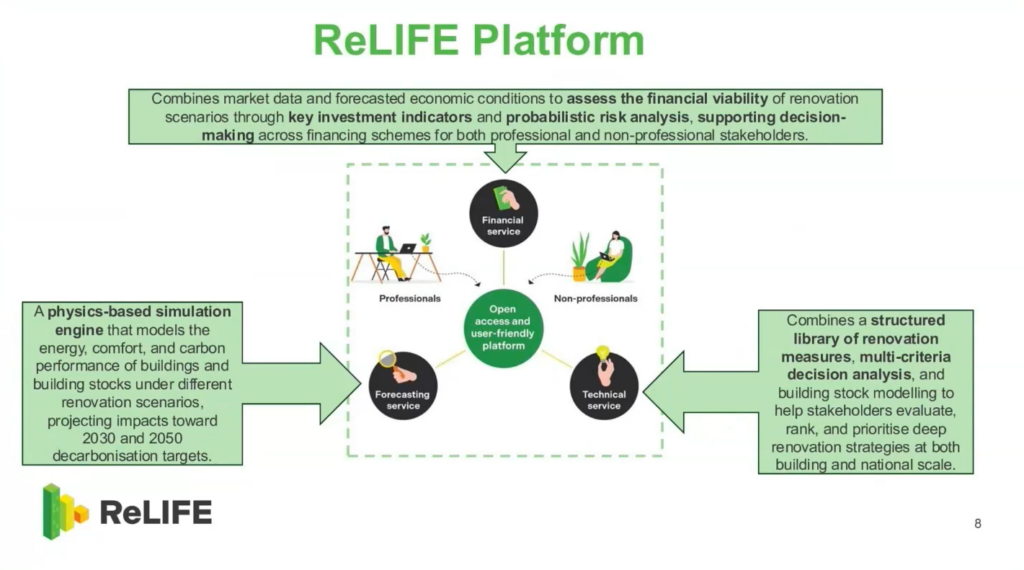
The platform offers three services. A financial service calculates indicators such as return on investment, payback time and net present value, helping a bank decide on a loan or a homeowner plan a renovation budget. A forecasting service simulates energy, comfort and carbon performance under different renovation scenarios up to 2030 and 2050. A technical service helps rank renovation strategies at building and national level.
ReLIFE is also testing a new way to map the building stock: machine learning applied to satellite imagery from Copernicus and the European Space Agency. This can detect renovation elements such as PV panels and track them over time. The services are being tested in five pilots across Greece, Austria and Spain.
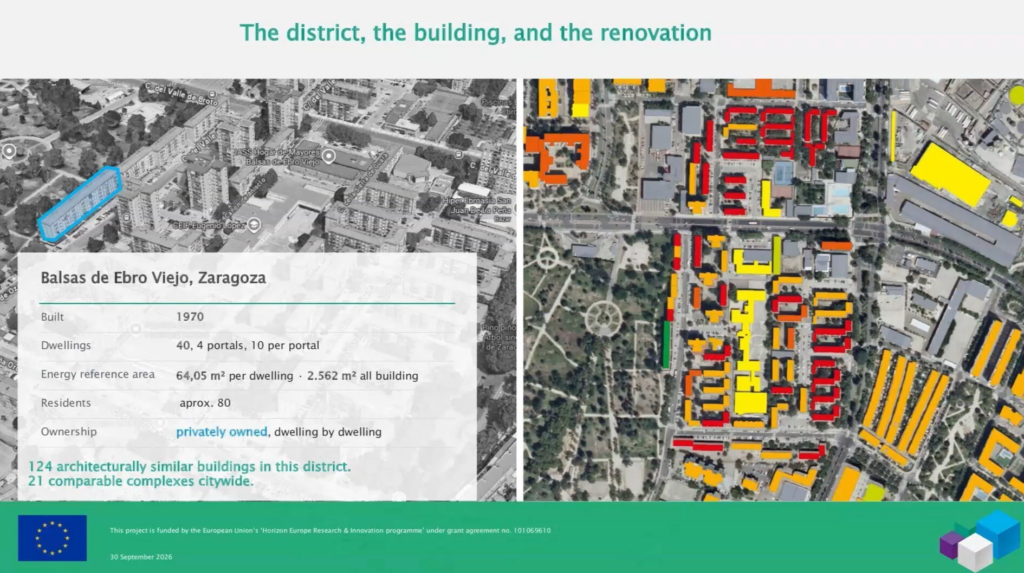
Clara Lorente Martin, from the InCUBE team, then presented the first post-renovation results from the Zaragoza demo site: a 1970s social housing block of 40 privately owned dwellings, typical of many Spanish neighbourhoods. It is now the only EPC A-rated building in its district. The retrofit upgraded the thermal envelope, cutting thermal transmittance by at least 70%, and installed heat pumps for heating and cooling in most dwellings, while gas boilers remain for hot water.
Comparing a baseline from November 2023 with around nine months of data since January 2026, non-renewable primary energy has dropped by about 30%. Gas use is down by roughly two-thirds, while electricity use has risen by around 12% as heating is electrified. Savings are slightly below what was predicted, largely because the building’s photovoltaic system is still awaiting connection to the grid.
Comfort has improved in winter, with the share of too-cold hours falling from 15% to 7%. In summer, however, overheating hours have increased, a reminder that residents need support in using shading and ventilation after insulation. Collecting complete data from 40 separate households also proved a real challenge, and work is ongoing on a method to fill data gaps.
Clara closed with a broader point: a renovation works like insurance. When energy prices spike, as they did after the war in Ukraine, a better-performing home saves the most and keeps bills more stable.
In a live poll, participants pointed to data quality and occupant behaviour as the main reasons measured performance differs from predictions. Asked what would make them more confident in assessing a renovation project, most chose better financial information.
The panel discussion brought both perspectives together. Clara noted that buildings in models behave “too perfectly”: in reality, set points vary between families, some residents use blinds and cross-ventilation better than others, and vacant neighbouring flats increase heat loss. Simon added that everyday habits, such as opening windows while heating or cooling is running, can waste energy and even damage heat pumps. Both agreed that simulations and real monitoring are needed side by side, and that better forecasts depend on more and better data at scale.
The speakers also discussed how satellite imagery, now available at resolutions down to around 10 cm, could fill gaps where national data is missing, for example to estimate renovation rates or detect heat pumps and PV systems from above. The session closed with a look at renovation subsidies in Spain and Italy, where upfront payments, delays, limited funding pots and disagreements between co-owners can all slow down retrofitting and erode trust in support schemes.
This webinar showed how EU-wide data and real-world monitoring complement each other: one helps plan renovations at scale, the other shows what really happens once residents move back in. Together, they build the evidence needed to make Europe’s renovation wave both ambitious and reliable.